
Destination
Ngorongoro Crater
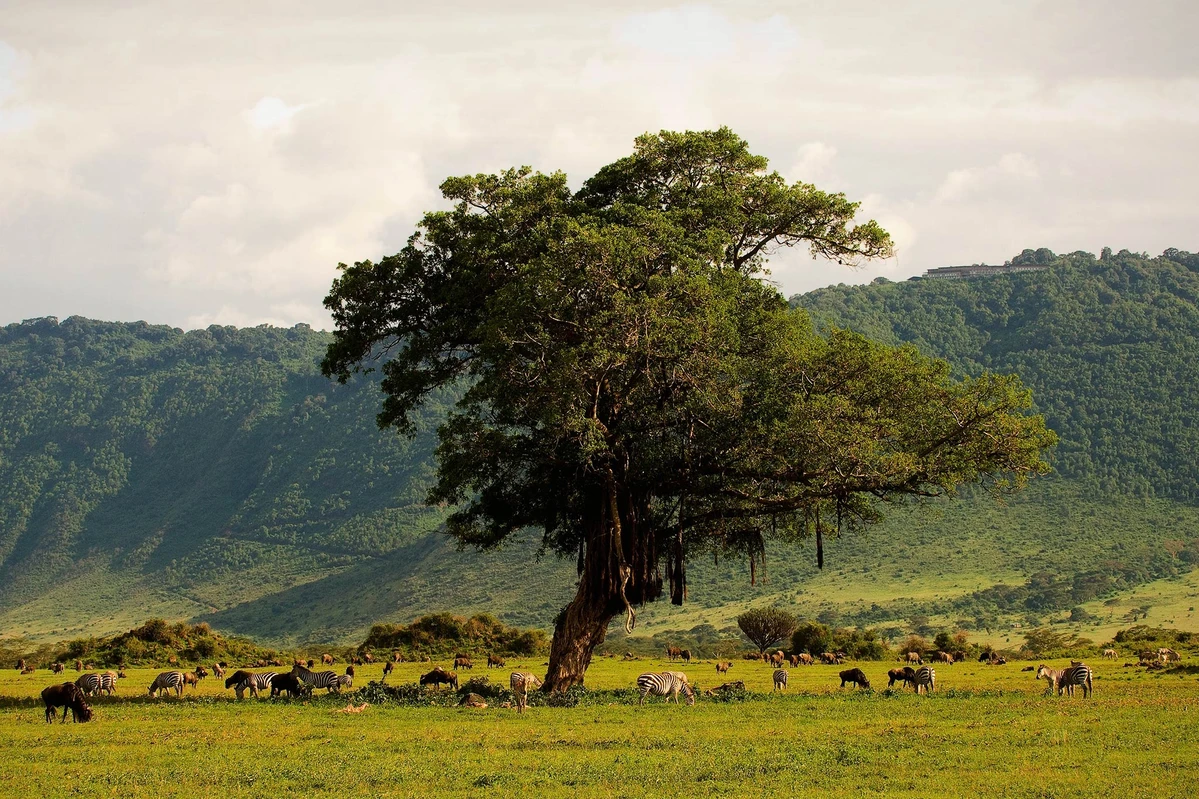
Home to the world's largest unbroken volcanic caldera and one of Africa's densest concentrations of wildlife.
Destination Overview
The Ngorongoro Conservation Area covers 8,292 km² (3,202 sq mi) of highland Tanzania, roughly 180 km — about a two-and-a-half to three-hour drive — west of Arusha, bordering the Serengeti to the north and west. Its centerpiece, the Ngorongoro Crater, is the world's largest unbroken, unflooded volcanic caldera, formed when a giant volcano collapsed on itself an estimated two to three million years ago. The crater floor spans 260 km² and sits around 1,800 meters above sea level, some 610 meters below a rim that rises to roughly 2,200–2,400 meters — a difference in altitude that makes the rim noticeably colder than the wildlife-rich floor below. Protected since 1959 and inscribed as a UNESCO World Heritage Site in 1979 (with mixed natural and cultural status added in 2010), Ngorongoro is unlike Tanzania's national parks in one key respect: it's a multiple-use conservation area where Maasai communities continue to live and graze livestock alongside the protected wildlife.
That combination of geology, wildlife, and living culture is what makes Ngorongoro one of the most complete single-day safari destinations in Tanzania. The crater floor holds an estimated 25,000 large animals at any given time, including all of the Big Five — among them a small, closely protected population of black rhino — and one of the densest, most intensively studied lion populations anywhere in the world. Because the crater is a largely closed ecosystem rather than one wildlife migrates through seasonally, game viewing stays reliably strong year-round, though the dry season (June–October) offers the clearest roads and easiest descent. Most travelers visit as part of a broader northern circuit itinerary, combining Ngorongoro with the Serengeti, Lake Manyara, and Tarangire, and often adding stops at nearby Olduvai Gorge — the "Cradle of Mankind," where Mary and Louis Leakey uncovered pivotal early hominid fossils — and the slow-moving volcanic dune known as the Shifting Sands.
The Ngorongoro Crater Floor
Descending onto the crater floor is, for many of our clients, the single best game drive of their entire Tanzania trip. Around 25,000 large animals live within the crater at any given time — one of the highest wildlife densities in Africa — packed into a landscape small enough that a single day's drive can cover most of it.
Vehicles typically enter via the steep Seneto descent road on the crater's western rim and exit via Lemala or Windy Gap to the east, so a full day inside rarely means retracing the same route twice. Because the crater floor is essentially a closed system, cut off from the seasonal migrations that move wildlife elsewhere on the northern circuit, its predators and prey are locked together year-round — which is exactly why sightings here stay so consistently good no matter when you visit.
Black Rhino and the Big Five in One Crater
Ngorongoro is one of the most reliable places in Tanzania to see all of the Big Five in a single outing, including a small, closely guarded population of black rhino — among the rarest and most sought-after sightings on the entire northern circuit. Numbers here are still recovering from historic poaching: from roughly 108 individuals in the mid-1960s, the population fell to under a dozen at its lowest point before conservation efforts brought it back to around 55 today, so every sighting is a genuinely hard-won one.
The crater's lions have their own remarkable story. In 1962, a disease outbreak linked to biting stable flies wiped out almost the entire pride, leaving just nine females and one male. Seven immigrant males that wandered in between 1964 and 1965 rebuilt the bloodline, and by the mid-1970s the population had rebounded to well over 100 — making the crater's lions one of the most intensively studied populations on Earth, and a textbook case of a genetic bottleneck and recovery that researchers still reference today.
Flamingos on Lake Magadi
At the center of the crater floor, the shallow, alkaline waters of Lake Magadi regularly host thousands of lesser flamingos, along with pelicans, storks, and other waterbirds, adding a splash of color and a good stop for photography partway through a crater game drive. The lake's size and shoreline shift noticeably between wet and dry seasons, so the birdlife on display can look quite different depending on when you visit.
Lerai Forest and the Bulls-Only Elephants
Tucked against the crater's southern wall, Lerai Forest is a stand of yellow-barked acacia — locally called "lerai," or fever trees — that provides the only dense cover on the entire crater floor, and the resulting habitat pulls in wildlife you won't easily find on the open grassland. It's one of the best places in the crater to spot leopards, along with baboons, vervet monkeys, bushbuck, and waterbuck.
The forest's elephants are a highlight in their own right: almost the entire population living on the crater floor is made up of old bull elephants, many carrying enormous, ground-sweeping tusks, rather than the breeding herds of females and calves you'd expect elsewhere. It's thought that female herds largely abandoned the crater floor generations ago in favor of areas with more consistent forage, leaving these solitary, elderly bulls as some of the most photographed individual animals in Tanzania.
Empakaai Crater
A quieter, less-visited sister caldera to the northeast, Empakaai Crater holds a deep soda lake ringed by forest, reached by a steep half-day hike down a 300-meter descent. The lake itself is nearly 62 meters deep and about 6 km across, its highly alkaline water often rimmed with a crust of white soda ash along the shore. Flamingos are a regular sight here, and the descent through montane forest alive with birdlife, blue monkeys, and — on a clear day — views across to the still-active Ol Doinyo Lengai volcano, makes the walk itself as much a highlight as the crater floor.
Olmoti Crater
Olmoti Crater offers a shorter, more accessible walking option — roughly a 45-minute guided hike up to the rim, with wildlife sightings possible along old Maasai cattle paths, followed by a further descent to a set of waterfalls where the Munge River tumbles out of the crater on its way toward Lake Magadi. It's a manageable half-day outing with none of the crowds of the main crater floor, and a good option for travelers who want a walking safari without committing to Empakaai's longer, steeper hike.
Olduvai Gorge — The Cradle of Mankind
On the conservation area's edge, Olduvai Gorge is one of the most significant paleoanthropological sites on Earth, where research led by Mary and Louis Leakey through the mid-20th century uncovered some of the earliest known hominid fossils, including specimens of Homo habilis that reshaped scientific understanding of early human evolution. A small on-site museum displays fossil casts and tools alongside the actual excavation sites, making it an easy, thought-provoking stop on the way to or from the crater — especially for travelers with any interest in archaeology or human origins.
Shifting Sands
Near Olduvai, the Shifting Sands is a crescent-shaped dune of dark volcanic ash blown from the still-active Ol Doinyo Lengai volcano to the east. Held together by static and its own crescent shape, the dune migrates slowly across the plain — roughly 17 meters a year — without losing its form, a genuinely strange and photogenic natural phenomenon found in only a handful of places worldwide. Maasai communities have traditionally regarded it as a sacred site, adding a cultural layer to what is already one of the more unusual stops on the northern circuit.
Maasai Village Visits
Because Maasai communities live within the conservation area itself, a visit to a local village (known as a boma) offers a rare, easily accessible window into traditional pastoralist life — from the famous adumu jumping dance performed by young warriors, to a firsthand look at how homes, cattle herds, and grazing land are managed in a way that has continued largely unchanged for generations, even as the surrounding landscape has become a global conservation icon.
Crater Rim Walks and Birdwatching
Guided walks along the forested crater rim offer sweeping panoramic views down into the caldera and excellent birdwatching in the montane forest that rings it — a good complement to a crater floor game drive, and one of the few walking opportunities on this part of the northern circuit. Early morning walks are especially rewarding, when mist often clings to the crater floor below and burns off gradually as the sun rises over the rim.
Gateway to the Southern Serengeti and Ndutu Plains
Ngorongoro sits right on the doorstep of the Ndutu area and the southern Serengeti plains, where the Great Migration's calving season unfolds between January and March, drawing enormous concentrations of predators to feed on the newborn wildebeest calves. That proximity makes Ngorongoro a natural base for travelers timing their trip around the migration, letting you combine a crater game drive with a day or two on the calving grounds without a long additional transfer.
Activities in Ngorongoro Crater
- Full-day crater floor game drives
- Wildlife photography
- Maasai cultural village visits
- Bird watching at Lake Magadi
- Hiking on the crater rim
- Visiting Olduvai Gorge
Year-Round Weather in Ngorongoro Crater
The dry season, from June through September or October, brings afternoon temperatures on the crater floor of around 19°C (66°F), with clear skies and excellent visibility for game drives. Nights turn distinctly cold across the conservation area during this period, and it can genuinely freeze on the crater rim overnight, so warm layers for early morning departures are essential rather than optional. October usually stays sunny, though the first short rains can occasionally arrive before the month is out.
November and December bring the short rains, with crater floor temperatures warming slightly to around 23°C (73°F) in the afternoon, while the rim still drops to roughly 6°C (43°F) at night. Showers tend to fall in short afternoon bursts rather than lasting all day, so they rarely interfere with a full-day crater visit, and the landscape greens up noticeably compared to the dry season's dust.
January and February form a brief, generally dry interlude between the two rainy seasons, with conditions similar to the short rains but with less consistent rainfall. As elsewhere on the northern circuit, the exact start and end of this dry break can shift somewhat from year to year.
The long rains run from March through May, with crater floor temperatures again around 23°C (73°F) by day and the rim near 6°C (43°F) at night. Rain falls on many days during this period, though rarely for the entire day, and April and May can bring occasional cold fronts on top of the rain. Roads can turn muddy in places, but this remains one of the quietest, most affordable times to see the crater, with far fewer vehicles sharing the floor.
Related Trips
Discover Tanzania
Your questions answered
Where is Ngorongoro, and how do we get there?
The Ngorongoro Conservation Area sits about 180 km — roughly a two-and-a-half to three-hour drive — west of Arusha, bordering the Serengeti to the north and west. The crater floor sits at around 1,800 meters above sea level, with the rim considerably higher, at roughly 2,200–2,400 meters, which makes for a noticeably cooler climate than the plains below.
We handle the transfer for you as part of every Ngorongoro itinerary, in a safari-fitted 4x4 with a pop-up roof for photography.
When is the best time to visit Ngorongoro?
Ngorongoro is one of the few places in Tanzania that works well year-round. Because wildlife concentrates permanently on the crater floor rather than migrating seasonally, game viewing stays reliably good in both the dry season (June–October) and the wetter months, though the dry season does offer clearer roads and easier descent into the crater.
How many days should we plan for Ngorongoro?
A single full day is enough to descend into the crater, spend several hours on a game drive across the floor, and climb back out — and for many of our clients, that's exactly how Ngorongoro fits into a broader northern circuit itinerary. If you'd like to add a visit to Olduvai Gorge or one of the area's other craters, we'd suggest building in an extra half-day.
Can Ngorongoro be combined with other parks?
Yes — it's one of the most natural stops on the entire northern circuit, sitting almost directly between Lake Manyara and the Serengeti. We regularly build itineraries that link Ngorongoro with the Serengeti, Lake Manyara, and Tarangire as one continuous overland safari.
What do fees cost, and are they included in our price?
Ngorongoro has its own fee structure, separate from Tanzania's national parks — a conservation area entry fee plus a crater service fee for descending onto the crater floor, both paid electronically. Rates are reviewed periodically, so rather than quote a figure that may be out of date, we build the current fees directly into your itinerary quote — you won't need to handle any payments at the gate yourself.
What is Ngorongoro best known for?
The Ngorongoro Crater itself — the world's largest unbroken, unflooded volcanic caldera, formed when a giant volcano collapsed roughly two to three million years ago. Its floor spans about 260 km² and drops some 610 meters below the rim, forming a self-contained wildlife haven that holds an estimated 25,000 large animals at any given time, one of the highest densities of wildlife anywhere in Africa.
What wildlife will we see in the crater?
The crater is one of the best places in Tanzania to see all of the Big Five, including a small, closely protected population of black rhino — among the rarest sightings on the northern circuit. It also holds one of the densest lion populations in the world, alongside large herds of wildebeest, zebra, and buffalo, and flocks of flamingo on the soda waters of Lake Magadi. Interestingly, giraffes, impala, and crocodiles are notably absent from the crater floor itself, a quirk of its enclosed ecosystem.
What is Olduvai Gorge, and can we visit it?
Olduvai Gorge, on the edge of the conservation area, is one of the most important paleoanthropological sites in the world, where research led by Mary and Louis Leakey uncovered some of the earliest known hominid fossils — evidence that has helped shape our understanding of human origins. It's often called the "Cradle of Mankind," and we can easily add a stop at its museum and excavation sites en route to or from the crater.
Do the Maasai still live in Ngorongoro?
Yes — unlike Tanzania's national parks, Ngorongoro is a multiple-use conservation area, and Maasai communities have lived and grazed livestock within its boundaries since before it was protected in 1959. It's one of the only places on the northern circuit where you can see traditional pastoralist life continuing alongside protected wildlife, and many of our itineraries include the option of a respectful visit to a local Maasai village.
Where will we stay?
Most lodges and tented camps sit along the crater rim, offering dramatic views down into the caldera, with a range of comfort levels from mid-range to some of the most exclusive properties in Tanzania. Because the rim is considerably colder than the crater floor, rim lodges tend to have fireplaces and heavy bedding even in the warmer months. We choose accommodation based on your budget and how the day fits into your wider itinerary.
Is Ngorongoro safe? What health precautions should we take?
Ngorongoro is a well-established, well-patrolled conservation area and safe when visited with an experienced guide — always stay inside the vehicle in wildlife areas and follow your driver-guide's instructions. Tanzania is a malaria-risk area, so we advise speaking with a travel clinic about antimalarial medication before your trip, along with routine precautions like repellent and covering up around dusk. The crater rim's altitude and cold mornings are worth planning around, but they're not a health concern for most travelers. We're glad to share more detailed guidance once your dates are confirmed.
What should we pack for Ngorongoro?
Layers are essential here more than almost anywhere else on the northern circuit — mornings on the crater rim can dip to around 10°C (50°F) even when the crater floor warms to a comfortable 25°C (77°F) by midday. Pack a warm jacket alongside your usual neutral-colored safari clothing, a hat, sunglasses, and high-SPF sunscreen. We send every client a full packing list tailored to their travel dates once their itinerary is booked.